When the Toads Return in February
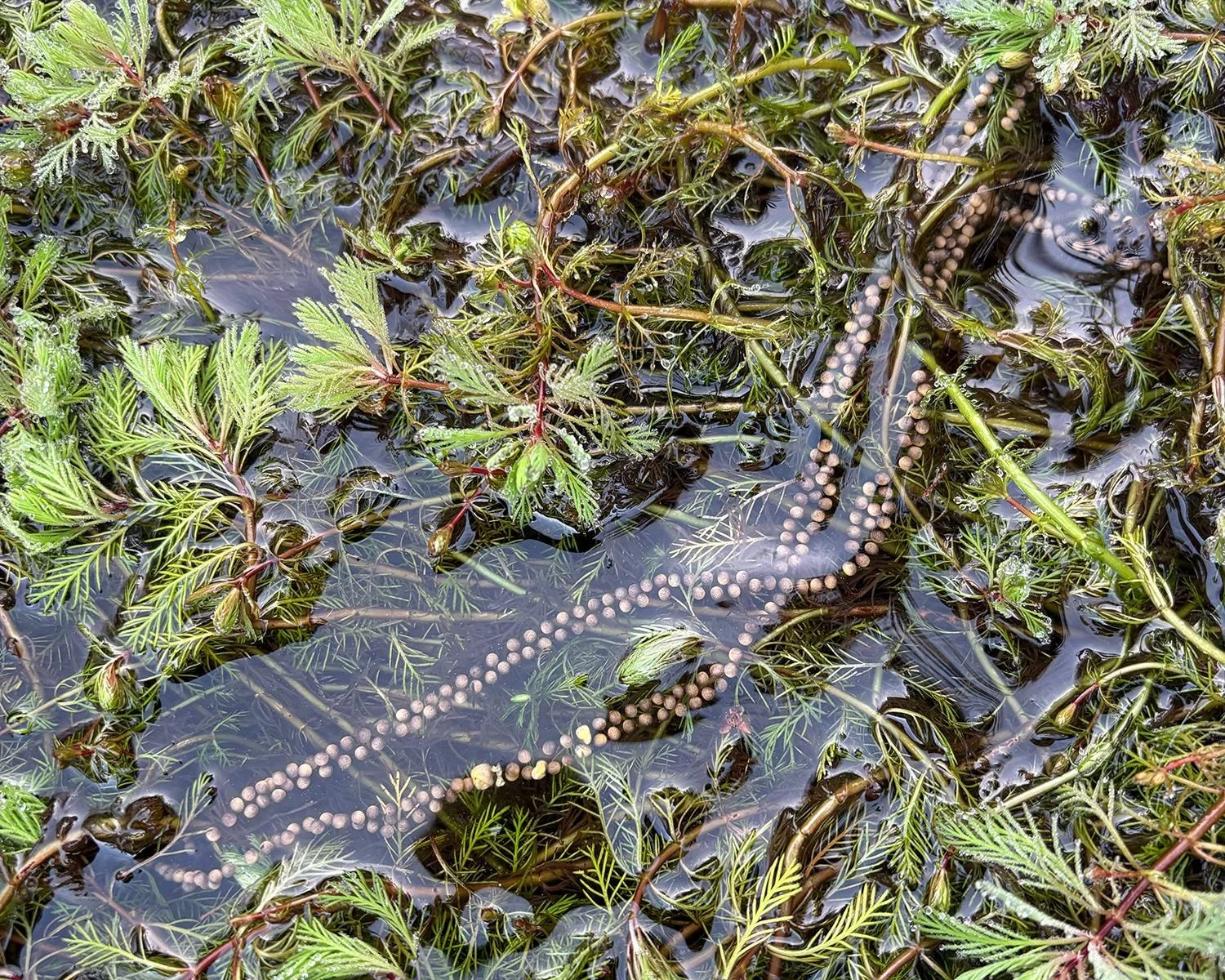
Ribbons of toad eggs in a pond. Photo © Yury Li-Toroptsov
It is still February, at least according to the calendar, yet the weather in France over the past days has followed a different logic. A warm air mass has travelled north from Africa and temperatures have risen well above what this time of year would normally allow. Winter has not ended, and yet something in the garden has decided that it has.
The pond, which only a short while ago seemed inert, has come back to life. The toads have emerged from hibernation and have already begun their love parades, which in itself would be surprising enough in late March, but feels almost surreal in February. Yesterday morning I noticed long translucent ribbons wrapped around the stems of aquatic plants in the fish pond. Toad eggs. A new generation is already on its way, before winter has formally released its grip.
If one pays attention to the way plants react to the smallest amounts of sun and water at this time of year, one witnesses something that urban life tends to make us forget. Nature does not spend much time contemplating its next move. It does not wait for ideal conditions, nor does it seek reassurance before beginning again. A slight increase in warmth, a few hours of light, a brief spell of rain, and growth begins. Shoots appear where there was nothing the day before. Buds swell. Moss spreads quietly over stone. You cut grass in one place and it reappears somewhere else. The underlying principle seems to be simple, almost blunt in its persistence: grow, gain space, blossom, produce progeny, and then move on, leaving space for another generation.
In the city, nature is present, but it is coiffed, trimmed, and subdued. Trees are pruned into shapes that fit our avenues. Lawns are cut short to match our sense of order. Flowerbeds are arranged according to aesthetic plans rather than seasonal necessity. It takes only a short distance beyond the confines of the urban perimeter to encounter a nature that runs its own course, indifferent to our schedules and to our preferences. There, time becomes visible again through rhythms rather than through deadlines.
These rhythms are not abstract. They structure everything: dormancy, emergence, mating, reproduction, decay, renewal. To live in accordance with them is not a romantic idea but a biological one. When one phase is rushed or ignored, the cycle weakens. When several are consistently denied, the system begins to falter.
I feel that city life made me forget much of this, even though it was the basic reality of my early years. I was born and raised on a farm, where seasonal change dictated the tempo of daily life. Reconnecting with nature outside, even through something as modest as observing a garden pond in February, brings back this older knowledge with surprising force. It also reconnects one with a different kind of nature inside oneself, one that seems to follow similar laws of latency, activation, growth, and rest.
To step outside and witness these processes is not only to observe the world but to remember something about how one’s own life unfolds. Find a moment to do that.